
A consulting practice of StaySafe Verified LLC
Safety leadership, on demand.
Senior safety expertise for organizations that need it — without the full-time hire. Programs built, hazards analyzed, incidents investigated, and cultures changed, led by a Certified Safety Professional (CSP) with twenty years in the field.
What we take off your plate.
Right-sized to your risk, with a graded approach. Not every operation needs the same depth — we scale the rigor to the hazard, the headcount, and the stakes. A single audit, a program build, or standing fractional leadership — never more program than your risk demands, never less than it requires.
Fractional safety leadership
A senior safety leader embedded in your operation — days per month, not headcount.
OSHA & State-program compliance
Written programs built to federal OSHA or your State Plan’s requirements — matched to how your people actually work, and ready to hold up under inspection.
Job hazard analysis
Task-by-task analysis with the crews who do the work — practical controls, not paperwork.
Incident investigation
Root-cause investigation that fixes systems instead of blaming people — and stands up to scrutiny.
Training & safety culture
OSHA 10- and 30-hour Outreach courses delivered by an authorized OSHA Outreach instructor — plus training people actually remember, in plain language.
Site audits & readiness
An honest look before someone else takes one — findings ranked by risk, with a plan you can run.
Risk management
Identify, assess, prioritize, control — a risk register your leadership actually uses, so resources go where the consequences are highest.
Where the work happens
Not from a conference room — on your floor, with your crews, in the work as it actually happens.
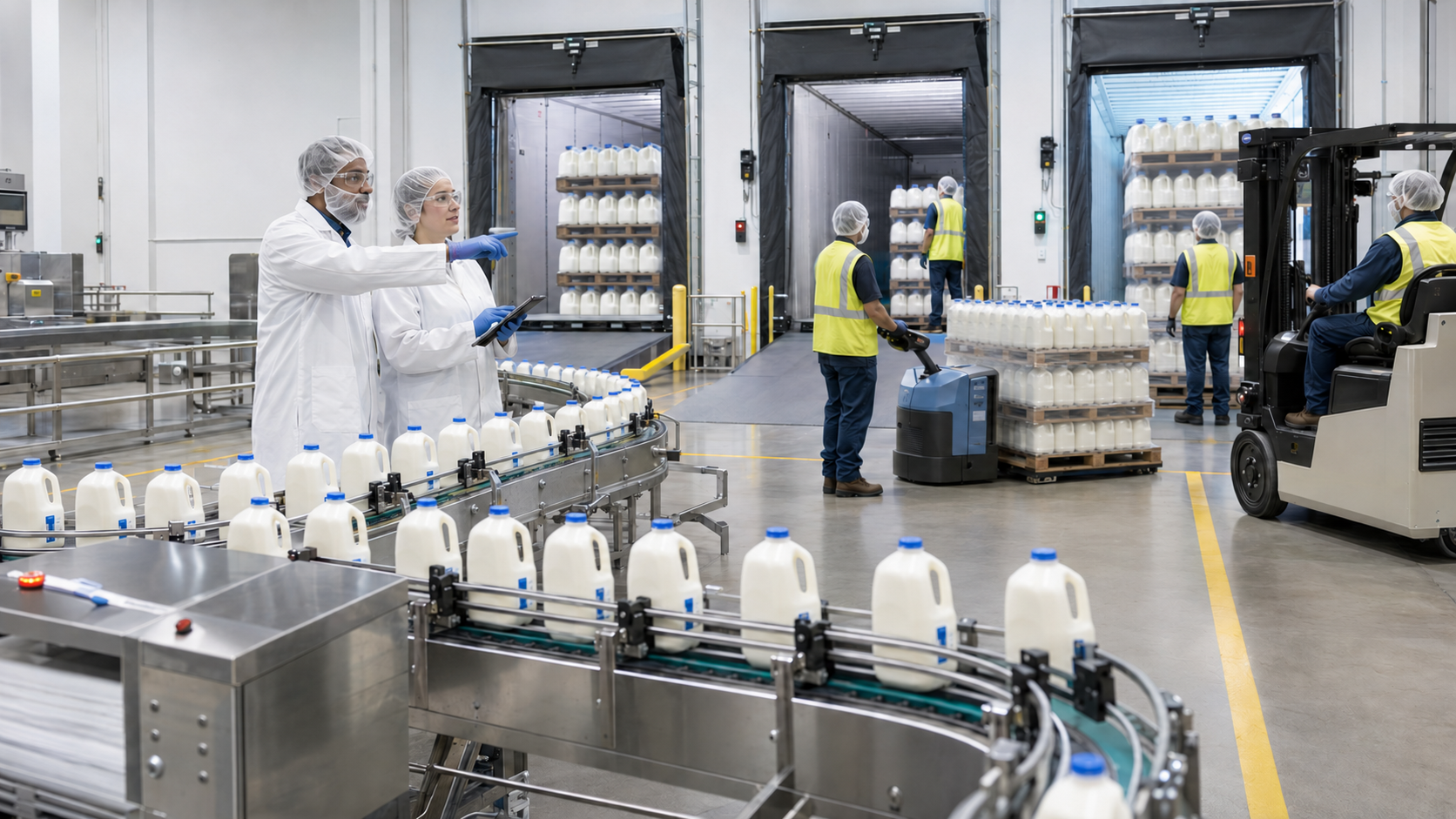
Dairies & food processing
Where sanitation, machines, and forklifts share the same floor.
Dairies and food plants run a rare mix of hazards — wet floors and CIP chemicals, ammonia refrigeration, machine guarding on packaging lines, powered industrial trucks working the same docks as people. We know the rhythm of a processing floor, and we build programs that protect the crew without slowing the line.
How safety actually improves
Plan. Do. Check. Act. — a wheel that never stops turning.
Every program we build runs on the management-system cycle behind ANSI/ASSP Z10 and ISO 45001 — five core functions working as one continuous loop, not a binder on a shelf.
Leadership & worker participation. The hub the wheel turns on — management commitment and the crew’s voice in every decision.
Plan. Identify hazards, assess risk, set objectives — before work begins.
Do. Put controls, training, and safe work practices into the actual work.
Check. Audits, inspections, and incident learning — measure what’s really happening.
Act. Management review and correction — then the wheel turns again, a little higher each time.
Guiding principles of a safety management system
A program is a document. A management system is how a company behaves.
The same discipline that governs quality and information-security management systems applies to keeping people whole. These are the principles every engagement is built on — whatever the industry, whatever the size.
Leadership owns it. Everyone builds it.
Safety set by memo fails. It has to be visibly led from the top and shaped by the people who do the work — the crew’s voice is a design input, not a suggestion box.
Risk decides the rigor.
A graded approach: the depth of the program matches the severity of the hazard. High-consequence work earns layers of control; low-risk tasks don’t get buried in paperwork.
Manage the work as it’s actually done.
Procedures written for an imaginary plant protect no one. We build controls around the real task, the real schedule pressure, and the real floor.
Fix systems, not blame.
When something goes wrong, the question is what allowed it — not who to punish. Blame buries the truth; systems thinking surfaces it and prevents the repeat.
Measure what matters — then act.
Leading indicators over lagging luck. Inspections, near-miss learning, and honest metrics feed decisions — a finding nobody acts on is a liability, not a record.
Never “done.”
Operations change, people change, hazards change. A living system reviews itself on a rhythm and improves every cycle — that’s the wheel above, turning for good.
Who leads it
Chad — Certified Safety Professional (CSP)
Twenty years leading safety across heavy industry — plants, job sites, fleets, and crews — with the scars and the checklists to show for it.
“Good safety isn’t about fear. It’s about people going home whole — every shift.”
How engagements work
Three steps, priced before work begins.
01
A frank conversation. What’s keeping you up — inspection, incident, growth?
02
A scoped assessment. Findings ranked by risk, priced before work begins.
03
The right-sized engagement. One project or standing leadership — never more than you need.
From groundbreaking to grand opening
Bring in safety leadership before you need it.
Site safety planning, contractor coordination, hazard analysis before the first shovel, and the standing presence that keeps a project’s safety culture from drifting as the schedule tightens.
Replies within one business day · Choose “Professional Services” on the contact form and it reaches the right desk